challenge courses
Why a High Ropes Course?
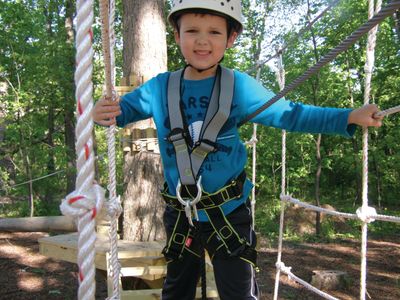
Ropes challenge courses can be seen as the ultimate group or team challenge. Ropes courses are a combination of both vertical challenges and horizontal challenges, constructed from wood, cable and ropes installed above the ground and strung between trees, wood poles or steel framework. Ropes courses can be built both indoors and outside.
When groups or individuals go up on a ropes course there is a great opportunity for them to learn about risk taking, their own perceived limits, how they perform under pressure, how they give and receive support from other people, and how working with others collaboratively can help an individual achieve more than they thought they could accomplish.
Challenge courses can be tailored for use with a wide variety of populations and facilitated to accommodate a wide spectrum of group dynamics. ESI builds ropes courses for professional organizations who train high performance work teams, nonprofit development organizations, treatment facilities, summer camps, resorts, conference centers and more. Our builders have many years of construction experience building adventure elements for the outdoor industry.
ESI will work closely with you and your organization to design a ropes course consisting of the appropriate activities for the type of groups you will be serving and customized for your site.
types of courses
Static Belay Courses
The Traditional Static Belay System (Maze Course) uses a set of “Y tails” or lanyards with two legs. Attached at the waist to the center of the lanyard, the participant manually opens and closes a connector on the end of each leg of the lanyard. These clips open with the push of two buttons simultaneously. The participant is responsible to ensure that they are always attached to at least one belay cable (or approved and rated clip-in point). The potential for a “total unclip” exists with this system and requires a higher staff to participant ratio to ensure participant safety. In the long term, the increased staffing costs make this a more expensive option. Staff observes every transfer of the participants. They can only view one transfer at a time.
There are several Smart Belay Systems for Static Belay Courses. They have a feature that minimizes the potential for the "total unclip." Learn more about these Smart Belay products.

Dynamic Ropes Courses
With a dynamic belay one participant at a time goes up and completes the activity. This allows the group to focus on that one person. These types of courses can be one single element or a series of elements each with one participant in the air.
Traditional Dynamic Belay systems require a climber and a second person or a team of people to keep the rope taut and the participant safe as they climb up, traverse across and get lowered down. A variety of belay devices with various levels of ease and functionality are available for use – depending on programming needs and budget.
Continuous Belay System
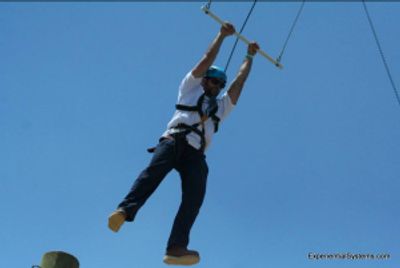
Continuous Belay Systems and Track Belay Systems eliminate the need for any transfer besides the first one to start the course and the second one to exit the course. Once connected, the participants lanyard is connected to a shuttle or trolley that is in a steel track or riding on a cable system.
The continuous nature of these systems prevents the possibility that the participant will become disconnected form the fall arrest system while on the ropes course. As participants move from element to element, the shuttle or pulley must move over or though some form of a bracket attached to the support structure (pole, tree or column).
This option is usually best for commercial use. If you’re trying to get a large amount of people though during the time of operation, this would be your best option.

Indoor Ropes Course
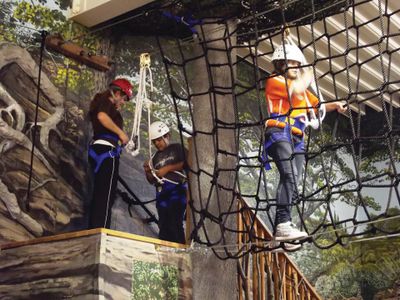
Indoor ropes courses offer all the same challenges of their outdoor counterparts with the added benefit of being able to be used year round regardless of weather. Great for schools, universities, field houses, park districts, resorts, cruise ships, and more. ESI can design an indoor solution perfect for your facility. We offer a variety of elements with varying difficulties to meet your organizations goals and needs. We also offer to guide you through each step to help you make the best choices for your program’s needs.
When groups or individuals go up on a ropes course there is a great opportunity for them to learn about risk taking, their own perceived limits, how they perform under pressure, how they give and receive support from other people, and how working with others collaboratively can help an individual achieve more than they thought they could accomplish.
Low Initiatives and Kid's Courses
We at Experiential Systems offer a wide variety of low initiatives. Each with a different goal or function. They provide groups with obstacles to overcome both mentally and physically. These challenges require teamwork to be completed successfully. The activities are designed to allow a trainer or facilitator to work with a group to help them deal with teamwork objectives and prepare them for bigger challenges and greater challenges. Groups are encouraged to take what they learn here and apply it to real world challenges. Teamwork and cooperation are fundamentals of these exercises.
Kid's challenge courses are becoming more and more popular. These courses are built low to the ground, with just enough challenge to keep small children excited. These not only provide a great standalone attraction, but they can be incorporated as part of a larger challenge course to provide entertainment for the younger set.
We also build adaptive use courses. ESI can design wheelchair friendly courses and activities and obstacle courses that serve guests of all abilities. Contact us today and we can design a course to suit your specific needs.
Learn more about our Low Initiatives and Kids Courses.